Google Just Changed How Brands Show Up in Search — Here Is What It Means
If you run a small brand, a content business, or a local company and you have been struggling to control how you appear on Google — this week brought something worth paying close attention to.
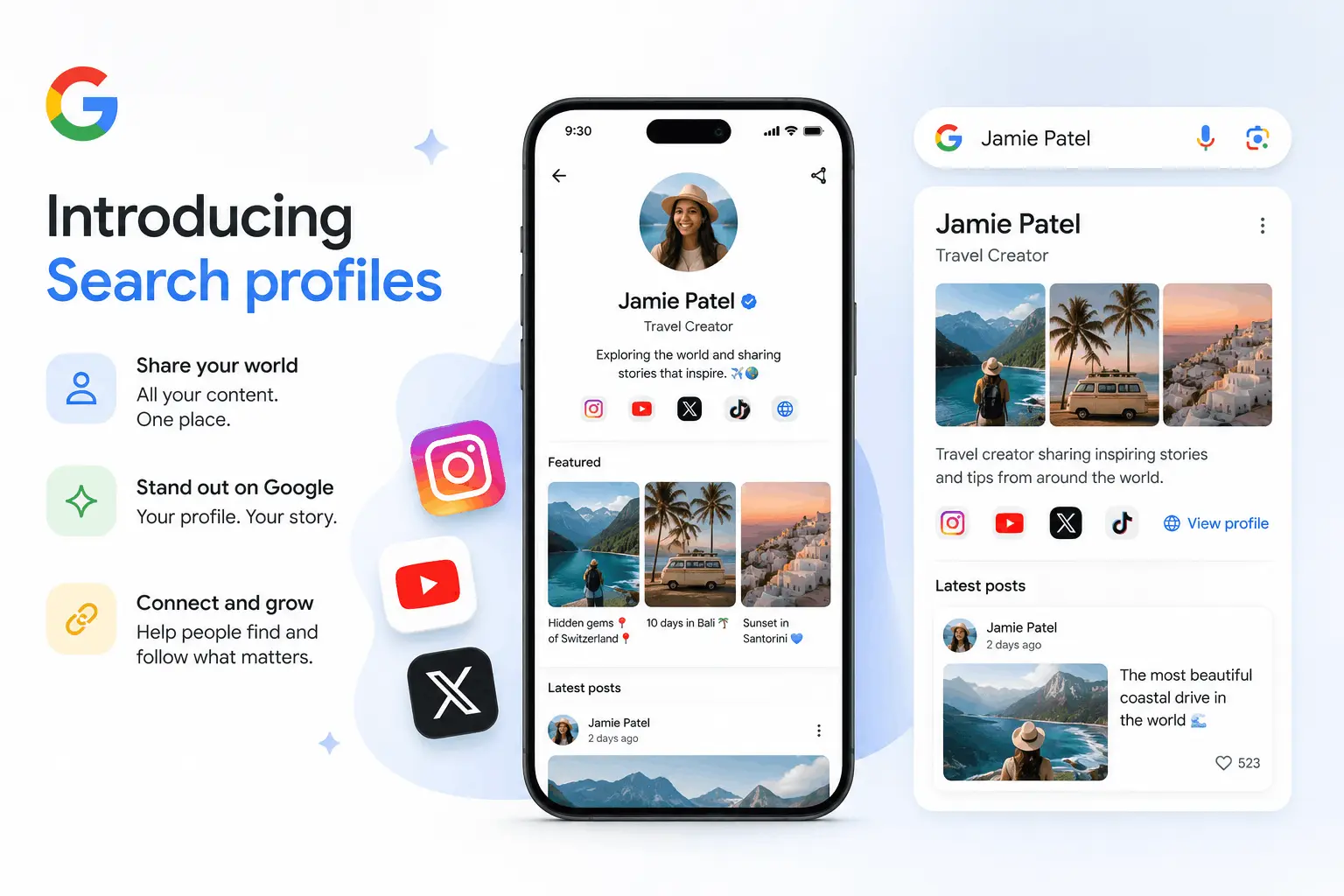
Google has just launched Search Profiles — a new feature designed for creators, publishers, and organisations that allows them to build a customisable, verified public presence directly on Google Search.
This is not a minor update. It is a fundamental shift in how individuals and brands can shape their own visibility on the world’s most used search engine.
Here is everything you need to know — what it is, how it works, who can use it right now, and how small brands should be thinking about it.
What Is Google Search Profile?
A Google Search Profile is a shareable, customisable page that brings together all of your social accounts, websites, posts, and links into one place — hosted directly by Google.
Think of it as your official presence on Google Search — not just a result that appears when someone searches for you, but a structured, verified profile that you control and that Google actively surfaces.
Once set up, your Search Profile can trigger a Knowledge Panel — the information box that appears on the right side of Google Search results when someone searches for your name or brand. This Knowledge Panel can display:
- Your profile photo
- Your name and bio
- Your latest posts from connected platforms
- Links to your social accounts and website
- A direct link to your Search Profile
- An AI-generated summary based on your bio
For brands and creators, this is significant. A Knowledge Panel has historically been something that Google decided to give you — or not. Now, for eligible users, it is something you can actively claim and shape.
Why This Matters for Brands
Before this feature existed, your appearance on Google Search was largely out of your hands.
Google would pull information from wherever it found it — Wikipedia, news articles, social media, directories — and stitch together whatever Knowledge Panel it felt was accurate. You had limited ability to correct it, update it, or add to it.
Search Profiles change that equation.
For the first time, creators, publishers, and organisations have a direct channel to tell Google: this is who I am, this is what I create, these are my platforms, and this is how I want to appear.
For small brands specifically, the implications are real:
Controlled first impression — When a potential customer, partner, or investor searches your brand name, your Search Profile shapes what they see first.
Centralised presence — Instead of your audience having to piece together your presence from scattered search results, your profile brings everything into one place — your website, your social accounts, your best content, your latest posts.
Knowledge Panel visibility — A Knowledge Panel dramatically increases the visual real estate your brand occupies on a search results page. It signals credibility and authority before someone has even clicked a single link.
AI summary — Google generates an AI-based summary from your bio. In an era where AI is increasingly shaping how people discover information, having a verified, accurate summary on Google is a meaningful trust signal.
Who Is Eligible Right Now?
This is where it is important to be honest about where things currently stand.
Google Search Profiles have just launched — and the current eligibility requirements are specific:
Follower threshold:
- At least 100,000 followers on a single supported platform — Instagram, YouTube, or X (Twitter)
- If you are only on TikTok, the threshold is 300,000 followers
Geography:
- Currently available in the United States only
- Google has stated plans to expand to other countries later in 2026
Profile type:
- Designed for individual creators, publishers, and organisations
- Must have an active public profile with an established online presence
What this means practically: If you are a small brand or early-stage business in India, you may not be eligible to claim a Search Profile today.
But — and this is the important part — what you do right now determines whether you are ready when eligibility expands.
How Google Search Profile Works — Step by Step
For those who are eligible, here is how the setup process works:
Step 1 — Check Eligibility Visit Google’s Search Profile page and check whether your account meets the current requirements.
Step 2 — Claim Your Profile Click “Claim your profile” and log in with your Google account. You will be prompted to connect your supported social platforms to verify your identity.
Step 3 — Connect Your Platforms Link your Instagram, YouTube, X, or other supported accounts. These connections verify who you are and pull your latest content into your profile.
Step 4 — Customise Your Profile Add your bio, website links, and any additional platforms or content you want to highlight. You can pin your best posts to the top — ensuring your most important content is what people see first.
Step 5 — Access and Manage Once claimed, access your profile at profile.google.com/account or through the Google App. Update it as your brand evolves.
Step 6 — Knowledge Panel After claiming, a Knowledge Panel may begin appearing when people search for your name or brand — showing your photo, latest posts, and a link to your Search Profile.
What Small Brands Should Do Right Now
Even if you cannot claim a Search Profile today, the steps you take now directly determine your readiness when this feature expands to India and lowers its eligibility threshold.
Here is a practical action plan:
1. Build Your Follower Base on Supported Platforms
The current threshold is 100,000 followers on Instagram, YouTube, or X. That is the target to work towards. Consistent, valuable content on these platforms is the path there — and the audience you build along the way has value independent of the Search Profile feature.
2. Claim and Optimise Your Google Business Profile
Google Business Profile is available right now, to every business, in India. It is Google’s existing tool for local business presence — and it feeds directly into how your brand appears on Google Search and Maps.
If you have not claimed and fully optimised your Google Business Profile yet, do it today. It is the foundation everything else builds on.
3. Build Your Verified Presence on Review Platforms
Google’s Knowledge Panels are informed by what it finds about you across the web. A strong, verified presence on trusted review platforms — including TrustAnalyser, where your business receives a verified TrustScore based on genuine customer reviews — contributes to the signals Google uses to understand and represent your brand.
The more verified, consistent, and credible your presence across trusted platforms, the stronger your eventual Search Profile will be.
4. Publish Consistently on Indexed Platforms
Every article you publish on LinkedIn, Medium, or your own website is a piece of public, Google-indexed content about your brand. This content shapes what Google knows about you — and therefore what it surfaces when someone searches for you.
Consistent publishing is not just content marketing. It is building the public record that Google will eventually use to populate your Search Profile and Knowledge Panel.
5. Keep Your Online Information Consistent
One of the most common reasons brands are misrepresented on Google is inconsistent information across platforms — different business names, addresses, descriptions, or bios on different sites.
Audit your online presence now. Make sure your name, description, and key details are consistent everywhere — your website, social profiles, review platforms, business directories. Consistency signals credibility to Google.
The Bigger Picture — Why Brand Visibility Is Becoming a Trust Signal
Google’s launch of Search Profiles is part of a broader shift in how search engines and AI tools are thinking about brand credibility.
The future of search is not just about ranking pages. It is about verifying identities, confirming authority, and surfacing trusted sources. Google, ChatGPT, Gemini, and Perplexity are all moving towards a model where verified, well-documented brands appear in answers — and unverified, inconsistently represented ones do not.
Search Profiles are Google’s latest step in that direction — giving verified creators and brands a direct line to shape how they appear. The eligibility requirements will expand. The feature will reach India. And when it does, the brands that have been building their verified presence consistently — on Google Business Profile, on review platforms like TrustAnalyser, on LinkedIn and Medium and Quora — will be the ones that benefit most.
Trust is not just something your customers feel. Increasingly, it is something search engines measure. And the brands that understand that — and build accordingly — will have a significant advantage in the years ahead.
Conclusion: The Window Is Open — Start Building Now
Google Search Profiles represent a meaningful shift in how brands can control and shape their presence on the world’s most important search engine.
The eligibility requirements mean it is not available to everyone today. But the direction is clear: Google is moving towards a verified, creator-controlled model of brand representation on Search — and that model will expand.
The small brands that will benefit most when it reaches India are the ones building their verified, consistent, credible presence right now — on every platform that matters.
Start with what is available today. Be ready for what is coming.
Want to build your brand’s verified trust presence in India? List your business on TrustAnalyser and start earning a genuine TrustScore — the trust signal that customers and search engines both recognise.