What Is Brand Reputation? — Definition
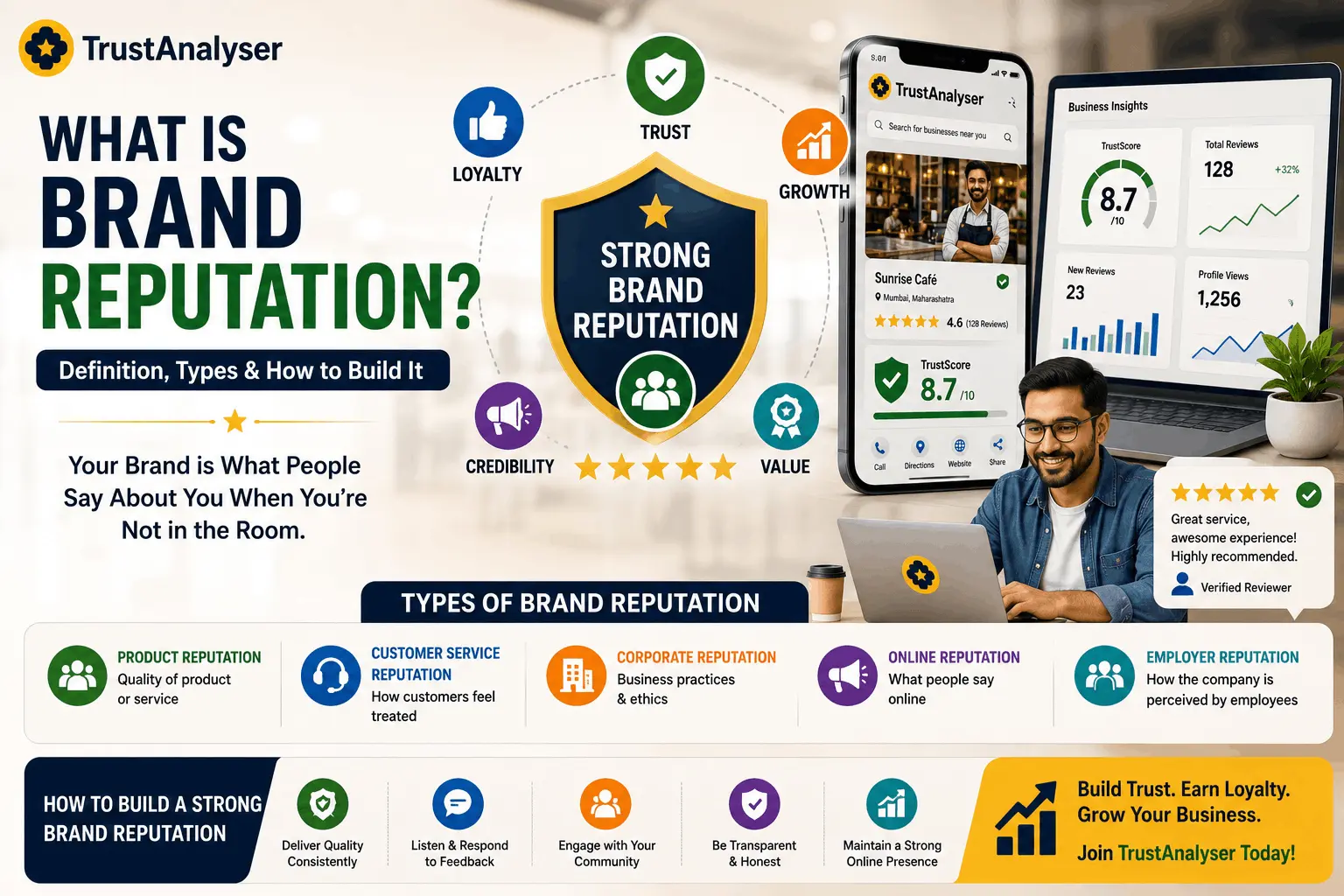
Brand reputation is the collective perception that customers, competitors, employees, and the general public hold about a business — based on their direct experiences, word of mouth, online reviews, and public presence.
It is not just what you say about your business. It is what others say about it when you are not in the room.
In practical terms, brand reputation answers one core question that every potential customer is silently asking: “Can I trust this business?”
A strong brand reputation means that when someone hears your business name — or discovers your profile on a platform like TrustAnalyser — their immediate instinct is confidence, not hesitation.
How Do You Define Reputation in a Business Context?
Reputation, in a business context, is the cumulative result of every interaction your business has ever had — with customers, the community, employees, and online audiences.
It is shaped by:
- The quality of your products or services
- How you handle complaints and negative feedback
- What your customers say in reviews and testimonials
- Your visibility and consistency on review platforms
- Your responsiveness and transparency as a business
Unlike advertising — which is entirely in your control — reputation is co-created by your customers. That is precisely what makes it your most valuable and most vulnerable asset.
What Are the Types of Brand Reputation?
Brand reputation is not a single, monolithic concept. It exists across several distinct dimensions:
1. Customer Reputation How your existing and past customers perceive the quality and reliability of your products or services. This is the most direct and impactful form — and it is what drives your TrustScore on TrustAnalyser.
2. Online Reputation What appears when someone searches for your business name online — your review scores, social media presence, mentions on news sites, and your profile on review platforms.
3. Local Community Reputation Especially critical for local businesses — this is how nearby customers perceive your business within their community. A high TrustScore on TrustAnalyser directly reflects and strengthens your local community reputation.
4. Employee Reputation (Employer Brand) How current and former employees describe working for your business. This affects your ability to attract and retain quality talent.
5. Social Reputation How your brand is perceived in terms of its values, social responsibility, and behaviour on public platforms.
For local businesses in particular, customer reputation and online reputation are the two most immediate drivers of daily footfall, conversions, and growth.
How Do You Describe Brand Reputation?
Brand reputation can be described across three core dimensions — often referred to as the 3 C’s of Brand Reputation:
Credibility — Does your business deliver what it promises? Credibility is earned through consistent quality and honest communication.
Consistency — Is the customer experience predictable and reliable every single time? Inconsistency is one of the fastest ways to damage reputation.
Community Trust — Do the people in your local area — your actual customers and neighbours — vouch for your business? This is what review platforms measure, and what TrustAnalyser’s TrustScore is specifically designed to quantify.
What Are the 4 C’s of Branding?
The 4 C’s of Branding provide a framework for building a brand that earns and sustains strong reputation:
1. Clarity — Your brand’s purpose, values, and promise must be completely clear — to your team and to your customers. Confusion erodes trust.
2. Consistency — Every touchpoint — your storefront, your social media, your product quality, your response to reviews — must deliver a consistent experience.
3. Credibility — Your brand must do what it says. Credibility is built through transparency, quality, and honest engagement with customer feedback.
4. Connection — The strongest brands build an emotional connection with their audience. For local businesses, this connection comes from being genuinely embedded in the community — and from the kind of authentic reviews that TrustAnalyser is built to collect and showcase.
What Are the 5 C’s of Branding?
The 5 C’s of Branding expand on the above with one critical addition:
1. Clarity — Defined purpose and brand promise
2. Consistency — Uniform experience across all touchpoints
3. Credibility — Honest, transparent business conduct
4. Connection — Emotional and community bond with customers
5. Competitiveness — A clear understanding of what makes your brand distinctly better than alternatives
For local businesses listed on TrustAnalyser, the TrustScore serves as a direct, transparent signal of the first four C’s — visible to every nearby reviewer browsing your profile.
What Are the 7 Key Elements of Brand Strategy?
A complete brand strategy that supports long-term reputation has 7 key elements:
1. Brand Purpose — Why does your business exist beyond making money? Businesses with a clear purpose earn deeper customer loyalty.
2. Brand Vision — Where is your business going? A compelling vision builds confidence among customers and partners.
3. Brand Values — What principles guide every decision your business makes? Businesses that live their values earn reputation organically.
4. Target Audience — Who are you serving? The sharper your understanding of your customer, the more precisely you can build trust with them.
5. Brand Positioning — How are you distinctly different from competitors? On TrustAnalyser, your TrustScore and business profile are a direct expression of your positioning.
6. Brand Voice and Communication — How do you speak to your customers — in person, online, and in your responses to reviews?
7. Reputation Management — The active, ongoing process of collecting genuine customer feedback, responding to reviews, and monitoring your brand’s perception — across platforms including TrustAnalyser.
What Are the 4 Brand Strategies?
The 4 core brand strategies define how a business builds and extends its brand over time:
1. Line Extension — Adding new products or variants under an existing brand name (e.g., a restaurant adding a new cuisine).
2. Brand Extension — Taking an established brand into a new category (e.g., a clothing brand launching a lifestyle app).
3. Multi-brand Strategy — Operating multiple distinct brands within the same market to capture different customer segments.
4. New Brand Strategy — Creating a completely new brand for a new product or market.
Regardless of which brand strategy a business pursues, reputation is the foundation that makes any strategy viable. A business with a poor TrustScore cannot successfully extend or grow its brand — because the underlying credibility is absent.
What Are the 4 Pillars of Brand Strategy?
The 4 pillars that support a sustainable brand strategy are:
1. Identity — Your visual and verbal brand identity: name, logo, tone, and communication style.
2. Positioning — The unique space your brand occupies in your customer’s mind relative to competitors.
3. Experience — The actual, lived experience customers have with your business at every touchpoint.
4. Reputation — The cumulative public perception that results from all of the above.
Of these four pillars, reputation is the only one that customers own, not you. It is earned through genuine experiences — and it is exactly what TrustAnalyser is designed to build and protect.
How to Check Brand Reputation — A Practical Guide
Knowing your brand reputation is not about vanity — it is about making informed decisions. Here is how to actively check it:
Step 1: Check Your Review Profiles
Look at all platforms where your business has reviews — Google, TrustAnalyser, social media. What is your average rating? What are the recurring themes in customer feedback?
Step 2: Monitor Your TrustScore
On TrustAnalyser, every business is assigned a TrustScore between 1 and 10 — based on verified reviews from real nearby reviewers. This single number gives you an immediate, honest snapshot of how your business is perceived.
Step 3: Search Your Brand Name
Google your business name regularly. What appears? News articles, forums, social mentions, review aggregators — all of these contribute to your online reputation.
Step 4: Analyse Sentiment Trends
Are recent reviews getting more positive or more negative? Are there specific complaints appearing repeatedly? Trends matter more than individual data points.
Step 5: Compare Against Competitors
On TrustAnalyser, you can see how your business TrustScore compares to similar businesses in your area. This benchmarking gives you a realistic picture of where you stand — and where the opportunity lies.
What Brand Has the Best Reputation — And Why?
Globally, brands like Apple, Toyota, and Patagonia consistently top reputation rankings — because they share common characteristics:
- They deliver consistent quality at every customer touchpoint
- They are transparent when things go wrong
- They actively listen and respond to customer feedback
- They have a clear purpose that resonates with their audience
- They have earned trust over time — not through advertising alone, but through genuine experiences
For local businesses, the same principles apply — just at a community level. The local restaurant, salon, or service provider with the highest TrustScore in their area has achieved exactly this: consistent quality, genuine reviews, and active reputation management.
The brands with the best reputation are not the ones that shout the loudest. They are the ones that are trusted the most. And trust is built review by review, interaction by interaction.
The 3-7-27 Rule — And What It Means for Brand Reputation
The 3-7-27 rule in marketing describes the layers of brand recognition:
- 3 impressions — A potential customer begins to recognise your brand
- 7 impressions — They start to remember your brand
- 27 impressions — They begin to trust your brand enough to consider a purchase
This rule underlines a critical truth for local businesses: trust is not built in a single interaction. It requires repeated, positive exposure.
On TrustAnalyser, every genuine review, every complete business profile, and every offer you list is another impression — building familiarity and trust with nearby reviewers who encounter your business multiple times before making a decision to visit.
Why TrustAnalyser Is Built for Brand Reputation Management
TrustAnalyser is not just a place to collect reviews. It is a complete trust ecosystem built specifically for local businesses.
Here is how every feature connects directly to brand reputation:
TrustScore (1–10) — A transparent, verified score that gives customers an instant snapshot of your business’s reputation. Unlike star ratings that can be gamed, TrustScore is built on verified reviews from real nearby reviewers.
Genuine Reviewer Community — TrustAnalyser’s Reviewer users are people actively looking for trustworthy local businesses. Their feedback is real, unfiltered, and valuable — both for your reputation and for improving your business.
Complete Business Profile — List your offers, products, and services. A complete, active profile signals credibility and professionalism to every potential customer who visits.
Location-Based Discovery — Nearby Reviewers discover your business organically — meaning the people seeing your profile are genuinely relevant, local prospects. This makes every review, every impression, and every TrustScore point count.
Paid Business Plans — Unlock the full power of TrustAnalyser’s platform — maximum profile visibility, full listings capability, and access to features that help you actively manage and grow your reputation.
Conclusion: Brand Reputation Is Not Built Overnight — But It Is Built Here
Brand reputation is the result of thousands of small decisions, interactions, and experiences — accumulated over time.
The businesses that understand this invest in it consistently: they ask for reviews, they respond to feedback, they keep their business profiles complete and honest, and they treat reputation management not as a one-time task but as an ongoing business discipline.
TrustAnalyser exists to make that process simpler, more transparent, and more effective for every local business.
Whether you are just starting to build your brand’s reputation or looking to strengthen and protect what you have already earned — your TrustScore is the place to start.
Register your business on TrustAnalyser today. Start building the reputation your business deserves.